
How do you find the best plastic surgeon in Austin? Start by redefining the question: “best” is not a citywide ranking anyone can award. The best surgeon is the one who is appropriately qualified and the right fit for your procedure, your goals, your safety needs, and your communication preferences. In practice, that choice generally combines verifiable plastic surgery credentials, procedure-specific experience, appropriate facility and anesthesia standards, honest discussion of risks and alternatives, consistent before-and-after documentation, clear communication, realistic expectations, reliable postoperative follow-up, and a treatment philosophy aligned with what you want.
This guide gives you an objective framework for evaluating any plastic surgeon — including ours. Wherever a claim matters, verify it independently through the primary sources linked below rather than taking any practice’s word for it.
What Does “Best Plastic Surgeon” Actually Mean?
When patients search for the “best,” they are usually weighing eight things at once — whether they name them or not:
- Qualification — is the surgeon certified specifically in plastic surgery?
- Safety — where is surgery performed, and with what anesthesia arrangements?
- Procedure fit — is this operation something the surgeon plans regularly?
- Experience — including revisions and combination procedures where relevant
- Communication — do you understand the plan, its limits, and its risks?
- Aesthetic alignment — do the surgeon’s results reflect what you consider natural?
- Follow-up — who cares for you after the operation, and for how long?
- Your specific needs — health history, anatomy, recovery constraints, and goals
No single surgeon is universally best for every patient and every procedure. A surgeon who is an excellent match for one patient’s facial surgery may not be the right fit for another patient’s body contouring. Keep the definition personal, and the rest of this guide becomes much easier to use.
Verify Board Certification Carefully
Three phrases sound similar but mean very different things. A licensed physician can legally practice medicine — but licensure alone does not indicate surgical specialty training. A “cosmetic surgeon” is a marketing term that physicians from various backgrounds may use; it is not itself a plastic surgery credential. Certification by the American Board of Plastic Surgery (ABPS), by contrast, reflects completion of accredited plastic surgery training and examination in the specialty. The certifying organization matters: check who issued the certification, not just whether the word “board-certified” appears.
Verification takes minutes: confirm certification through the American Board of Plastic Surgery or the American Board of Medical Specialties’ Certification Matters lookup, and confirm the Texas medical license and any board actions through the Texas Medical Board. Membership in professional societies can be a useful additional signal, but neither membership nor certification alone guarantees a specific result.

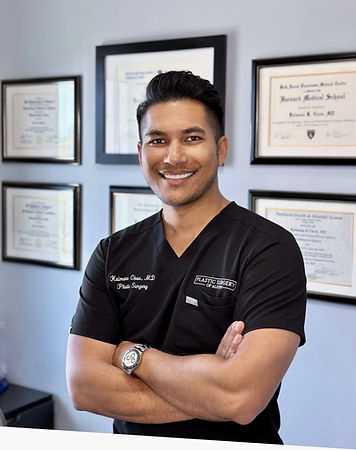
You can review Dr. Kaimana Chow’s training and credentials on his profile — and we encourage you to verify them through the same independent sources you would use for any surgeon.
Confirm the Surgeon Has Experience With Your Procedure
Experience should be relevant to the exact operation you are considering. Breast, body, facial, and nonsurgical procedures involve different anatomy, planning, and judgment, and volume alone is not the only consideration — how recently, how regularly, and in what combinations matter too. It is entirely reasonable to ask a surgeon how often they perform your procedure. Revision surgery and combination plans may require additional experience, and a thoughtful surgeon will explain the alternatives and the limitations of each approach rather than steering every patient to the same operation.
Procedure pages can help you prepare specific questions — for example, our overviews of breast procedures and body contouring describe how those consultations are typically structured.
The same applies to facial procedures and nonsurgical MedSpa treatments, which involve their own planning considerations.
Ask Where the Procedure Will Be Performed
The office where you consult is not necessarily where surgery happens. Ask specifically: In what facility will my procedure be performed? Is it accredited or licensed as applicable — for example, by an organization such as QUAD A (formerly AAAASF) or The Joint Commission — or is it a hospital setting? Who provides anesthesia, and what are the emergency protocols? A qualified surgeon should explain what level of facility and anesthesia care is appropriate for your specific procedure, and the answers should be easy to verify — facility accreditation and anesthesia arrangements are facts, not opinions.
You can read about our own setting on the clinic page, and we encourage you to ask these same facility questions of any practice you are considering.
Review Before-and-After Photos Critically
Before-and-after photos are evidence — but only when you read them carefully. Evaluate:
- Cases involving your procedure, with anatomy and starting concerns similar to yours
- Multiple cases, not one dramatic result — a single spectacular photo proves little
- Consistent views: the same angles before and after
- Consistent lighting, distance, and positioning between the paired images
- Front, oblique, and lateral views where relevant to the procedure
- Healed results, not only early postoperative photos
- Visible scars where appropriate — honest photography shows them

Remember that social-media images may be selectively presented, results naturally vary between patients, one patient’s outcome does not predict yours, and photos should never be digitally altered in ways that change the result. You can browse our before-and-after gallery with exactly this checklist in hand.
Evaluate the Consultation, Not Just the Sales Experience
The consultation is your best preview of how a surgeon thinks. Notice whether the surgeon:
- Listens to your goals before proposing a plan
- Examines your anatomy rather than quoting from across the room
- Explains what surgery can and cannot achieve for you
- Discusses alternatives, including smaller procedures or not operating
- Reviews risks honestly instead of brushing past them
- Answers questions directly, without pressure or countdown-style offers
- Explains recovery and follow-up in concrete terms
A surgeon willing to advise against surgery when it is not in your interest is showing you judgment you can trust. For a walkthrough of the visit itself, see what to expect during your plastic surgery consultation.
Ask Who Will Provide Your Care Before and After Surgery
Surgery is an episode; care is a relationship. Before you book, understand the whole arc: Who answers your questions before the operation? How many postoperative visits are typical, and who conducts them? What are the after-hours instructions if something concerns you at 10 p.m.? Which team members handle routine questions, and at what point does the surgeon become directly involved? What happens if your recovery differs from the expected course? Clear answers to these questions distinguish practices built around patients from practices built around bookings.
If you are traveling for surgery, follow-up deserves extra planning — our out-of-town patient resources describe how remote patients typically coordinate visits and stays.
Understand the Surgical Plan, Not Just the Procedure Name
Two qualified surgeons may honestly recommend different approaches for the same patient, because recommendations depend on anatomy, skin quality, existing scars, prior surgery, health history, goals, recovery constraints, and risk tolerance. That disagreement is not a red flag by itself — it is a reason to understand the why behind each plan.
Ask each surgeon to explain why this technique, why this combination, and why this sequence for your body. Be cautious of anyone claiming one technique is always superior for every patient; in plastic surgery, “always” is rarely accurate. The surgeon who can clearly explain their reasoning — including its trade-offs — is giving you real information.
Consider Communication and Aesthetic Alignment
Beyond credentials, weigh the softer signals: Does the surgeon understand what you actually care about, or substitute their own priorities? Is the terminology explained clearly enough that you could describe your own plan? Do the surgeon’s typical results match your idea of a natural outcome — some practices favor subtle change, others a more dramatic look? Do you feel able to ask questions freely? And do your expectations remain realistic after the conversation, rather than inflated by it? Rapport matters, but it should supplement verification, not replace it — “trusting your gut” alone is not a selection method.
Do Not Choose on Price Alone
Quotes that look comparable often are not. A surgical fee may bundle or exclude the surgeon’s fee, anesthesia, facility charges, garments, follow-up visits, and revision policies — so ask exactly what a quote includes before comparing numbers. The lowest price is not automatically the best value, and the highest price is not proof of superior quality. The one principle that should never bend: safety and qualifications are not features to trade away for a discount.
If cost is a real constraint, ask practices about payment options — our financing page explains the partners we work with. Keep in mind that financing changes affordability, not candidacy or risk.
Use Online Reviews Appropriately
Reviews are useful for what they can actually measure: patterns in communication, scheduling, office experience, and how a practice responds when something goes wrong. They cannot independently verify medical skill — reviewers rarely know whether their operation was technically well executed, only how they felt about the experience and outcome.
Read them in bulk and in context: small samples mislead, extreme emotional outliers deserve interpretation rather than face value, and a pattern across dozens of reviews means more than any single story. Then combine what you learn with credential verification, a consultation, and the safety questions above — reviews are one input, never the decision.
Warning Signs to Take Seriously
No single item on this list proves misconduct — but each is a reason to slow down and ask more questions:
- Credentials that are difficult to verify through independent sources
- Pressure to book surgery immediately, especially with expiring discounts
- Guarantees of specific results
- Dismissal of risks, or annoyance when you ask about them
- Reluctance to discuss alternatives, including not operating
- Inconsistent before-and-after photography — mismatched angles or lighting
- Vagueness about which facility will host your surgery
- Unclear anesthesia arrangements
- No clear follow-up plan after the operation
- Unusually vague fees or reluctance to itemize a quote
- Requests for inappropriate payment methods
- Communication that feels evasive when questions get specific
Questions to Ask at Every Plastic Surgery Consultation

- Are you certified by the American Board of Plastic Surgery?
- How often do you perform this procedure?
- Is this procedure appropriate for my anatomy and goals?
- What alternatives should I consider?
- Where will surgery be performed?
- Who will provide anesthesia?
- What are the most important risks in my case?
- How will scars be positioned and followed over time?
- What does recovery usually involve for this procedure?
- How many follow-up visits are typical?
- How are urgent postoperative concerns handled?
- May I review before-and-after cases relevant to me?
- What is included in the quoted fee?
- What happens if a revision is considered later?
These questions organize a conversation; they do not replace professional judgment. A good surgeon will welcome all fourteen.
Should You Meet With More Than One Surgeon?
Meeting more than one surgeon can be genuinely clarifying: it lets you compare recommendations, communication styles, qualifications, facility plans, recovery expectations, fees, and aesthetic alignment side by side, and it often surfaces questions you did not think to ask the first time. There is no fixed number of consultations every patient must attend — some patients find their answer in one visit, others in three. The goal is confidence in your choice, not a quota.
Choosing a Plastic Surgeon in Austin
The framework, in order:
- 1. Verify credentials through primary sources.
- 2. Confirm procedure-specific experience.
- 3. Understand the facility and anesthesia plan.
- 4. Evaluate relevant, consistent before-and-after results.
- 5. Assess communication and informed consent at the consultation.
- 6. Understand who provides follow-up, and how.
- 7. Compare the complete plan — not only the price.
- 8. Choose the surgeon who is appropriately qualified and aligned with your needs.
We built Plastic Surgery of Austin to hold up well under exactly this kind of scrutiny — and we would never claim to be the only appropriate choice in Austin. Apply the framework to every practice you consider, including ours.
When you are ready, review Dr. Kaimana Chow’s credentials, browse results in the gallery, or schedule a consultation and bring every question on this list.
References
This article is for general educational purposes only and is not medical advice. Every patient’s anatomy, health, treatment plan, recovery, risks, and results vary. Discuss your individual case with your surgeon.